
Devil’s Town
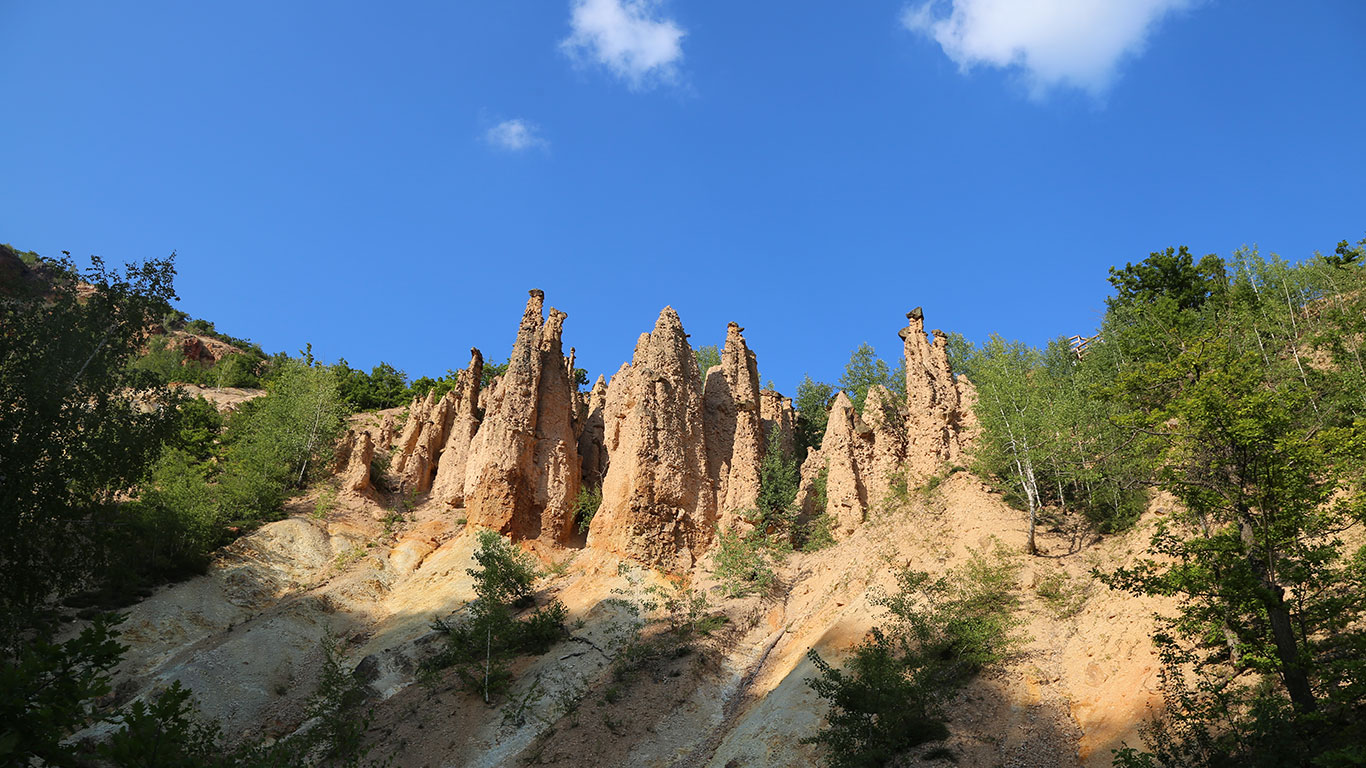
Nature Monument “Devil’s Town” is located in the area of the village of Đake, southeast of Kuršumlija (30 km). It can be reached by turning off the Niš–Kuršumlija–Priština road at Sastavci, then following a narrow asphalt road to the village of Zebice (5.7 km), and continuing along a good asphalt road to the entrance of the protected area (3 km), followed by a 900 m walk to the viewpoint.
This natural monument consists of two rare natural phenomena: earth formations as specific geomorphological shapes that create a highly attractive landscape, and two springs of extremely acidic water with high mineralization.
This valuable site was first protected in 1959. In 1995, by decree of the Government of the Republic of Serbia, Devil’s Town was declared a natural asset of exceptional importance and placed under the first category of protection. A total area of 67 hectares is protected. Devil’s Town was also the only representative of Serbia in the selection for the “New 7 Wonders of Nature”.
Earth Formations
The earth formations (“pyramids”, “heads”, or “towers”) are located in the valley of the Yellow Stream, between Paklena and Devil’s Gully. Devil’s Town consists of 202 formations of different shapes and dimensions, ranging from 2 to 15 m in height and 0.5 to 3 m in width, topped with stone caps.
These landforms were created by the action of rainwater on a former topographic surface made of loose but compact material.
The earth pillars consist of three layers of different composition: a marl layer up to 1 m thick at the base, a yellow clay layer up to 3 m thick in the middle, and the thickest sandstone layer above, covered with andesite slabs that act like umbrellas, protecting the loose ground from erosion.
This geomorphological phenomenon is unique in Serbia and very rare worldwide. Similar formations exist in the Alps (on both sides of the Brenner Pass in Austria and Italy, near Bolzano, as well as in Valérien in Haute-Savoie, France, and elsewhere). However, the towers of Devil’s Town are larger and much more stable, making this the most famous natural monument of its kind in Europe. Worldwide, the “Garden of the Gods” in the USA was better known.
Mineral Springs
In the immediate vicinity of Devil’s Town there are two springs with unusual properties. “Devil’s Water” is a cold and extremely acidic spring (pH 1.5) with high mineralization (15 g/l of water), located in “Devil’s Gully”. “Red (Devil’s) Spring” is the second spring, somewhat farther away and closer to the entrance of the protected area, with a pH value of 3.5 and lower mineralization (4.372 mg/l of water).

Legend
There are many legends about the origin of Devil’s Town. According to one legend, the formations represent petrified wedding guests who, under the devil’s influence, intended to marry a brother and sister. Another legend says they are petrified devils outwitted by schoolboys in a wager, while a third claims that the earth sculptures are devils from whom people freed themselves by spending a night beside the remains of the Church of Saint Petka, located near the formations.
Church of Saint Petka
The Church of Saint Petka in Devil’s Town was built on the foundations of a 13th-century church. The church itself is made of wood.
Saint Petka is believed to help the sick and troubled who visit this place. According to tradition, visitors touch the painful spot with a handkerchief while making a wish, then tie the handkerchief to a post so that all troubles and problems (the “devils”) remain in Devil’s Town. The handkerchiefs stay there for seven days, after which they are buried, symbolically leaving the troubles forever in the earth.

For organized groups, local guides are available in Serbian and English, while a special experience is the night tour, where the mystique of the formations is combined with lighting effects (LED illumination in 29 colors), music, and legends.
