
Discover Kuršumlija
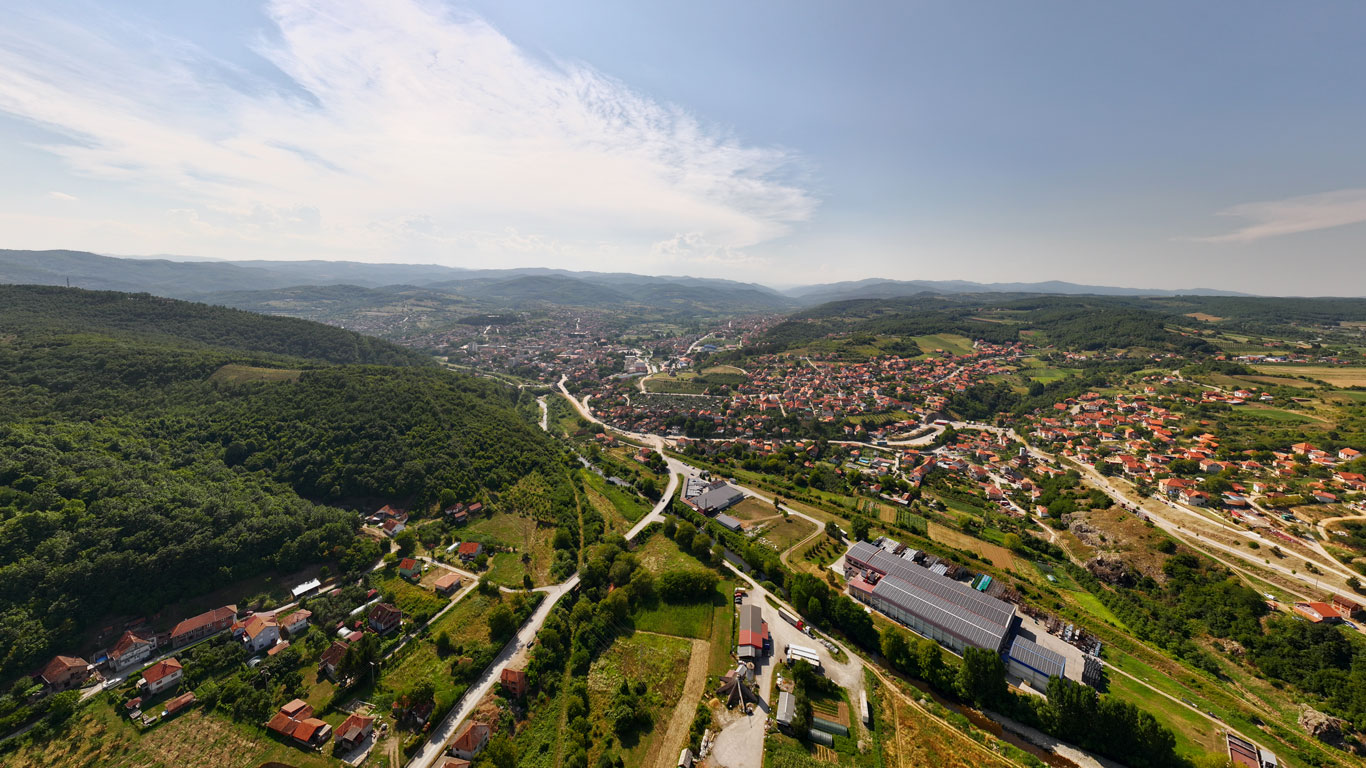
Municipality of Kuršumlija – Basic Information and Geographical Position
Kuršumlija is located in the central part of southern Serbia and administratively belongs to the Toplica District. It covers an area of 952 km2. The municipality is situated on the edge of the Kuršumlija basin and surrounded by numerous hills and mountains. It encompasses the upper basin of the Toplica River and its tributaries, the Kosanica and Banjska rivers, and stretches across the southeastern slopes of Kopaonik and the northwestern foothills of Mount Radan.
An important main road and railway route Niš – Prokuplje – Kuršumlija – Kosovo Polje passes through the valleys of the Toplica and Kosanica rivers. Via Blace, Kuršumlija is connected by road to Brus, Kopaonik, Kruševac, and Belgrade.
The municipal center, the town of Kuršumlija, lies at 386 meters above sea level and is located on three rivers – the Toplica, Banjska, and Kosanica. Within the municipality there are three spas – Lukovska Spa, Kuršumlija Spa, and Prolom Spa – as well as the world-famous attraction and natural monument of exceptional importance, Đavolja Varoš (Devil’s Town). Kuršumlija is 296 km from Belgrade, 73 km from Leskovac, 71 km from Kruševac, and 61 km from Priština. The terrain is hilly and mountainous, while the climate is moderately continental.
Historical Context
The natural features of the Kuršumlija region – thermal springs, mineral wealth, mild climate, fertile soil, rich forested hills, pastures, and favorable geographical position – created ideal conditions for settlement from prehistoric times, as confirmed by archaeological findings and the remains of Neolithic settlements.
During the Roman Empire, an important settlement called Ad Fines, meaning “at the end,” developed on the site of present-day Kuršumlija. It originated as a station along the famous Roman road Niš–Lješ and marked the final point administratively included within the territory of ancient Naissus. Numerous archaeological artifacts testify to the rich Roman heritage of Kuršumlija: coins, ingots, tombstones and votive monuments, milestones, weapons, pottery, and remains of necropolises and tombs in the courtyard of the Monastery of St. Nicholas. Another important Roman settlement and healing center developed in the area of present-day Kuršumlija Spa, known in Roman times as Aqua Basianarum. There is no doubt that wealthy Romans came to this ancient spa to treat rheumatic diseases, as confirmed by preserved monuments.
During Byzantine rule, a large number of fortresses and churches were built around Kuršumlija. The settlement received the name Toplice, first mentioned in 1019 in a charter issued by the Byzantine Emperor Basil II Bulgaroktonos.
During the second half of the 12th century, Stefan Nemanja ruled Toplica as an appanage prince. Between 1159 and 1168, he built his first two monasteries here, dedicated to St. Nicholas and the Holy Virgin. Since the domes of these monasteries were covered with lead that reflected brightly in the sunlight, the place became known as Bele Crkve (White Churches). These first two monasteries held exceptional importance for the Serbian medieval state. The Monastery of St. Nicholas became the seat of the Toplica Bishopric, and an important monastic marketplace developed nearby where silver ore was traded.

During Ottoman rule, Kuršumlija became the seat of local Turkish authorities, while the Serbian population withdrew into inaccessible regions. With the arrival of the Ottomans, the settlement changed its name to Kurşunlü Kilise (“Lead Church”). The settlement retained this name until the liberation from Ottoman rule, when it was first mentioned as Kuršumlje and finally as Kuršumlija after 1878.
During the First Serbian Uprising, Karađorđe’s insurgents controlled the area around Lukovska Spa for seven years and attacked Kuršumlija four times, while Stanoje Glavaš briefly liberated and held the town in 1806. Kuršumlija was finally liberated from the Ottomans on January 19, 1878.
In World War I, Kuršumlija became known for the Second “Iron” Regiment and the Toplica Uprising of 1917, officially led by Kosta Pećanac. During the war, Kuršumlija and its surroundings suffered enormous human and material losses.
In World War II, German forces occupied Kuršumlija on April 12, 1941. Bulgarian forces occupied the town and surrounding area from March 25, 1942, until liberation on August 28, 1944.
Kuršumlija received its first post office in 1881, its first urban development plan in 1888, Hotel “Europe” was built in 1892, and the first hospital in 1903.
During the liberation wars from 1912 to 1918, and especially during the Toplica Uprising of 1917 – the only uprising in occupied Europe at the time – the Kosanica district suffered great losses: 2,503 inhabitants were killed, 1,955 houses and 6,954 auxiliary buildings were burned.
In World War I, Kuršumlija was liberated on October 14, 1918.
During World War II, Kuršumlija made a significant contribution to the liberation struggle against fascist occupation. The region produced two National Heroes: Drinka Pavlović and Aleksandar Vojinović. Kuršumlija was liberated in World War II on August 28, 1944, on the feast day of the Assumption of the Virgin Mary.

Traces of the Past
Kuršumlija encompasses the area of ancient and freedom-loving Upper Toplica and Kosanica, whose pages and traces of the past are still not fully explored in a systematic way.
On the site of present-day Kuršumlija once stood the ancient settlement called Ad Fines.
From the Roman period, traces of ancient civilizations have been discovered: two milestones dating from the reign of Emperor Marcus Aurelius and coins of Emperor Philip. A Roman necropolis was uncovered near the Monastery of St. Nicholas. Lead, iron, zinc, silver, and gold ore were mined around Kuršumlija. The famous Roman road, later known as the Dubrovnik Route, passed through this region, carrying rich merchant caravans from Dubrovnik to Constantinople. Along the road, fortified structures and castles were built to protect caravans from bandits and to provide accommodation and horse replacements.
Around the thermal springs of the Kuršumlija spas, the ancient Romans built baths where soldiers, legionnaires, and church dignitaries were treated for rheumatic diseases. Evidence of this was found in Kuršumlija Spa, where an inscription records a high-ranking legionnaire thanking the nymphs for his healing.


The surroundings of Kuršumlija gained great importance in the 12th century during the reign of Stefan Nemanja. Bele Crkve (White Churches) were mentioned as a monastic market settlement. Sava Nemanjić founded the Belo-Crkva, later Toplica Bishopric here, with its seat in the Monastery of St. Nicholas, where he ordained the first bishop.
The Kopaonik region was the largest mining area in the Balkans. During the reign of King Vladislav, Saxon miners came here to extract ore. During the reign of King Milutin and Emperor Dušan, more than 250 smelters, foundries, and minting workshops were rediscovered according to current research.
